Embark vs Wisdom Panel (2026): Dog DNA Test Comparison Skip to comparison
Dog DNA comparison reviewed July 2026

Compare Embark and Wisdom Panel using decision factors that actually matter.

Choosing between Embark and Wisdom Panel is not only about which company advertises the largest number. The better choice depends on whether you want breed identification, inherited health screening, trait and behavior insights, relative matching, or a focused report you can discuss with your veterinarian.

Current brand claims dated U.S. at-home testing context Clear medical limitations
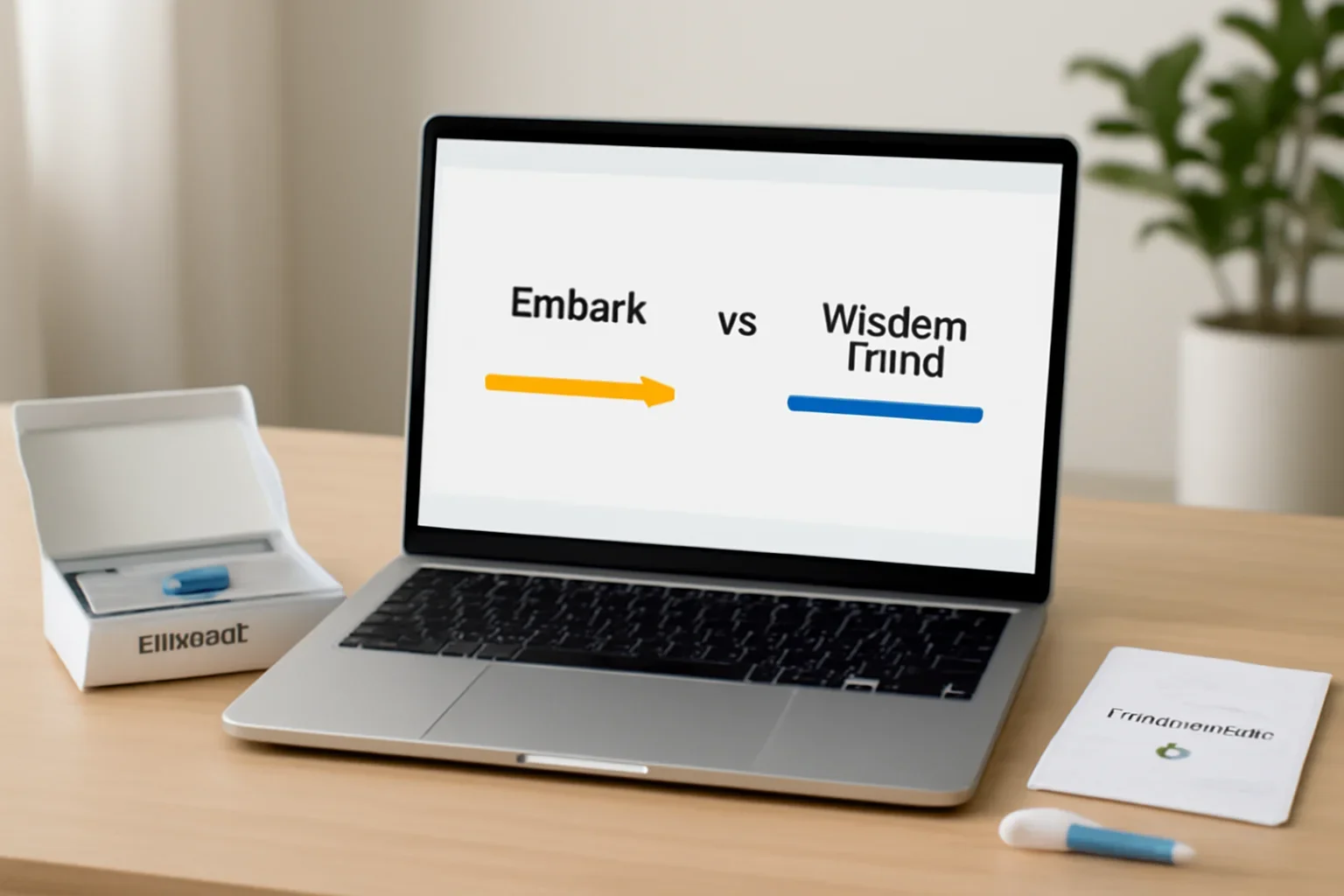
Embark vs Wisdom Panel guidance page shown on a laptop with dog DNA testing materials
Practical answer Embark may appeal more to shoppers prioritizing broad health screening. Wisdom Panel may appeal more to shoppers prioritizing breed breadth and behavior insights. The correct choice still depends on the exact kit.
Direct answer

Embark vs Wisdom Panel: which one should you choose?

Neither company is automatically best for every dog owner. Start with the result you need, then compare the specific kits that provide it.

The most useful test is the one that answers your actual question.

A large breed database does not replace health screening, and a broad health panel does not replace veterinary diagnosis. Compare report purpose before comparing headline numbers.

Embark may fit better when

Health screening breadth is a major priority

Embark currently promotes testing for 270+ genetic health risks, along with breed, trait, relative, and ancestry information on qualifying kits.

Review the exact Embark kit because Breed ID and Breed + Health products do not include identical features.

Wisdom Panel may fit better when

Breed breadth and behavior insights matter most

Wisdom Panel currently promotes detection across 430+ breeds and offers behavior, trait, health, and relative features depending on the selected product.

Health and behavior coverage varies between Breed Discovery, Essential, and Premium products.

A focused uDNA path may fit when

You already know the exact type of report you need

Breed identification, inherited disease screening, and a dog DNA profile serve different purposes. A focused path can prevent you from paying for report features you do not intend to use.

Compare pet DNA test categories
Side-by-side comparison

Compare current breed, health, report, and turnaround factors.

The figures below reflect information advertised by the brands in July 2026. Product features, promotions, databases, and processing windows can change.

Decision factor Embark Wisdom Panel What it means for you
Breed coverage 400+ breeds, types, and varieties
Brand-advertised coverage as of July 2026.
430+ breeds
Brand-advertised coverage as of July 2026.
The total is useful, but database diversity, breed definitions, reference samples, and reporting thresholds can matter just as much.
Health screening 270+ genetic health risks
Available through applicable health-focused products.
265+ health tests
Premium-level coverage; other kits may include less.
Confirm that the panel includes variants relevant to your dog’s known or suspected breed. More tests do not always mean more relevant tests.
Traits and behavior 55+ trait tests
Product-dependent.
50+ traits and 15 behavior tests
Product-dependent.
Trait and behavior reports can provide context, but environment, training, age, health, and individual variation still influence the dog.
Relative matching Relative-finder features are available with applicable dog DNA kits. Relative matching is available through applicable dog DNA products. The usefulness of relative matching depends on how many genetically related dogs are already present in that company’s database.
Typical laboratory window Approximately 2–4 weeks
After the laboratory receives and scans the qualifying sample.
Approximately 2–3 weeks
After the laboratory receives the sample.
Add outbound shipping, return shipping, activation, sample review, possible recollection, weekends, and holidays to estimate total time.
Report style Often emphasizes ancestry, health risks, traits, relatives, and research participation depending on the kit. Often emphasizes detailed breed composition, health, traits, behavior, relatives, and care-related context depending on the kit. Review sample reports before ordering. A clear report that answers your question can be more useful than a longer report.
Best starting point Shoppers who place strong weight on broad health screening and detailed ancestry-related features. Shoppers who place strong weight on breed detection breadth, behavior information, and a large pet database. Match the product to your dog, budget, intended use, and need for professional interpretation.

Pricing is intentionally not fixed in this table because promotions, shipping, bundles, taxes, and product versions can change. Review the complete checkout cost and current product inclusions before ordering.

Better buying decision

How to compare Embark and Wisdom Panel fairly.

Headline totals can be useful, but they do not tell you whether the selected kit fits your dog or the decision you are trying to make.

01
Define the report purpose

Decide whether you primarily need breed identification, inherited health screening, relatives, traits, behavior, or breeder support.

02
Compare the exact product level

Do not compare an entry-level breed kit with another company’s premium health kit as though they provide the same service.

03
Check breed and condition relevance

A larger panel may include many variants that are not equally informative for every breed or mixed-breed dog.

04
Review sample reports

Look at terminology, confidence language, result explanations, health classifications, and downloadable report options.

05
Calculate the complete cost

Include the kit, return shipping, taxes, upgrades, replacement samples, subscriptions, or optional services where applicable.

06
Plan how the result will be used

Health findings should be reviewed with a veterinarian and should not be treated as a confirmed diagnosis by themselves.

Dog owner comparing Embark and Wisdom Panel dog DNA test options on a laptop
Choose by purpose

When a focused uDNA page may fit better.

You may not need a broad all-in-one brand comparison. If your goal is already clear, begin with the report type rather than the company name.

Possible breed background

Dog breed test

Best suited to ancestry-style breed identification for mixed-breed, rescue, or adopted dogs with incomplete history.

Breed findings should not be treated as a diagnosis or a guarantee of behavior, size, temperament, or medical outcome.

Explore dog breed testing
Inherited genetic variants

Dog disease test

Designed for selected hereditary conditions or broader inherited-disease panels when health-related screening is the main goal.

The selected condition or panel should be relevant to the dog’s breed, family history, and intended use.

Explore dog disease testing
Identity and record comparison

Dog DNA profile

More relevant when the primary goal involves canine identity records, genetic profiling, or future sample comparison rather than ancestry alone.

Confirm the intended use and documentation requirements before selecting an identity-focused test.

Explore dog DNA profiles
U.S. location reality

What dog owners should consider based on where they live.

At-home dog DNA testing usually does not require living near a testing storefront. Location can still affect shipping time, return logistics, access to veterinary follow-up, and how quickly a replacement kit can arrive.

NY

New York

Review practical testing considerations for New York City, Long Island, Buffalo, Albany, upstate communities, and surrounding areas.

View New York guidance
FL

Florida

Compare ordering and at-home sample considerations for Miami, Orlando, Tampa, Jacksonville, and communities across Florida.

View Florida guidance
TX

Texas

Find practical guidance for Dallas–Fort Worth, Houston, Austin, San Antonio, smaller cities, and rural Texas communities.

View Texas guidance
OH

Ohio

Review DNA testing considerations for Columbus, Cleveland, Cincinnati, Toledo, and nearby communities throughout Ohio.

View Ohio guidance
OR

Oregon

Explore testing guidance for Portland, Eugene, Bend, Medford, the Willamette Valley, and rural Oregon communities.

View Oregon guidance
US

All U.S. locations

Browse available state guidance or start with the national finder when your state does not yet have a dedicated page.

Browse all locations
At-home testing process

How dog DNA testing usually works after you choose a kit.

Follow the instructions provided with the selected kit. Activation, collection, packaging, and return requirements can differ by company and product.

1

Choose the correct test

Confirm whether you need breed identification, health screening, identity profiling, relatives, traits, or a combination.

2

Activate the kit

Register the kit using the company’s required account or activation process before mailing the sample.

3

Collect a clean cheek swab

Follow food, water, drying, handling, and contamination-prevention instructions exactly as supplied.

4

Return and review

Mail the sample as directed, monitor its status, and read the final report within the provider’s stated limitations.

Sample quality matters: A contaminated, improperly dried, incorrectly labeled, or incomplete sample may delay processing or require recollection. Read the kit instructions before swabbing your dog.
Transparency and trust

Use dog DNA results as evidence with limits, not as a complete answer.

Consumer dog DNA reports can provide useful ancestry and inherited-risk information, but no report captures every part of a dog’s health, behavior, environment, or future.

  • Breed results can differ because companies use different reference databases, markers, algorithms, breed definitions, and thresholds.
  • A genetic health result does not confirm that a dog currently has a disease or will inevitably develop one.
  • A negative result only addresses the variants included in the selected test and does not rule out every genetic or acquired condition.
  • Symptoms, treatment decisions, breeding decisions, and medical concerns should be discussed with a qualified veterinarian.

How this comparison was prepared

Product coverage and turnaround references were reviewed against publicly available brand information in July 2026. Dynamic prices were excluded from the main comparison because promotions and product configurations can change. Readers should verify current inclusions, shipping terms, and processing estimates before purchase.

Frequently asked questions

Embark vs Wisdom Panel FAQs.

Clear answers to common questions people ask before ordering a dog DNA kit.

Is Embark or Wisdom Panel more accurate?

There is no single accuracy answer that applies to every breed, health variant, and report feature. Each company uses its own reference data, markers, algorithms, and reporting methods. Accuracy should be evaluated for the specific result you need rather than through one overall marketing claim.

Which company currently tests for more dog breeds?

As of July 2026, Wisdom Panel advertises coverage for 430+ breeds, while Embark advertises coverage for 400+ breeds, types, and varieties. These totals may change as reference databases and breed-detection systems are updated.

Which company currently offers more health screening?

Embark currently advertises screening for 270+ genetic health risks. Wisdom Panel Premium currently advertises 265+ health tests. The more important question is whether the selected product covers variants relevant to your dog’s breed and testing goal.

How long do Embark and Wisdom Panel results take?

Embark currently estimates approximately two to four weeks for many genotyping products after the sample is received and scanned by the laboratory. Wisdom Panel currently estimates approximately two to three weeks after its laboratory receives the sample. Shipping and sample-quality delays are additional.

Can Embark and Wisdom Panel return different breed results?

Yes. Results can differ because the companies may use different reference samples, breed definitions, genetic markers, algorithms, confidence thresholds, and methods for reporting small breed percentages.

Can a dog DNA health test diagnose a disease?

No. Consumer genetic screening can identify selected variants or inherited risk information, but it is not a complete veterinary diagnosis. A veterinarian should evaluate symptoms, examination findings, medical history, and any follow-up testing.

Which test is better for a rescue or mixed-breed dog?

Both brands offer products intended for breed identification. Compare the exact kit’s breed coverage, report detail, health features, relative matching, price, and turnaround time. A rescue dog’s appearance alone may not reliably predict its genetic ancestry.

What should a breeder compare before ordering?

Breeders should confirm breed relevance, inheritance patterns, panel coverage, result terminology, accepted documentation, mating-pair tools, genetic diversity information, and whether breed-club or veterinary guidance recommends additional testing.

Next step

Need help choosing the right dog DNA test?

Tell uDNA whether you want breed identification, inherited-disease screening, a dog DNA profile, or help comparing available products. We will help you identify the most relevant next step before you order.

uDNA support specialist helping a customer compare dog DNA testing options